
Views: 0 Author: Site Editor Publish Time: 2025-08-20 Origin: Site
Are you curious about how much it costs to put in a home EV charger in 2025? You will likely pay between $551 and $1,382. Most people pay about $964. Look at the table below for common costs:
| Cost Aspect | Cost Range (USD) |
|---|---|
| Average total installation | $964 |
| Typical price range | $551 - $1,382 |
| Possible low cost | $300 |
| Possible high cost | $2,500 |
| Level 1 charger unit cost | $300 - $600 |
| Level 2 charger unit cost | $700 - $2,000+ |
| Professional installation labor | $400 - $1,200 |
The price to install a home EV charger depends on many things. These include the charger type, labor, electrical upgrades, where you live, and site conditions. If you want good home EV charging, knowing these things helps you plan and save money.
Putting in a home EV charger in 2025 costs from $551 to $1,382. Most people pay about $964.
Level 2 chargers work best for most homes. They charge faster and cost less than Level 1 and Level 3 chargers.
If you hire a licensed electrician, the job is safe. This also keeps your warranty safe. You can get rebates and permits more easily.
You can save money with federal, state, and utility rebates. These help pay for the charger and installation.
Charging your EV at home costs less for each mile than public stations. You can save hundreds or even thousands of dollars over time.
When you check EV charger prices for homes in 2025, you see many options. The average cost for a Level 2 charger is between $500 and $2,500. Most people spend about $551 to $1,383 for everything. Level 1 chargers are cheaper because they use a normal outlet. Level 3 chargers are not made for homes. You usually see them at public charging spots. Their setup can cost $12,000 or even more.
Here’s a table to help you see the costs for each charger level:
| Charger Level | Typical Installation Cost Range (2025) | Notes |
|---|---|---|
| Level 1 | Very low or none | Uses a regular home outlet; usually no pro needed |
| Level 2 | $500 - $2,500 | Price changes with wiring, labor, permits, and distance |
| Level 3 | Not for home use | Found at public places; too costly for houses |
You may ask why prices are so different. The price depends on the charger type, how much wiring your house needs, and how far the charger is from your panel. Some homes need new parts to handle more power. Others just need simple wiring.
When you get a price for installing a home EV charger, you want to know what you pay for. Most costs cover these main things:
The EV charger unit (sometimes you buy it, sometimes it comes with the job)
Work done by a licensed electrician
Wires, conduit, and things like breakers
Fees for permits and paperwork
Checking the panel load and putting in breakers
Testing to make sure your charger is safe
Tip: Some prices also include a warranty for work and parts. Always ask your installer what comes with the job before you say yes.
Sometimes, extra work is needed. If your panel is old, you may pay more to upgrade it. If your charger is far from the panel, you might pay more for wires. Some homes need digging or fixing after the job. Local rules and codes can also change the price.
You feel safe when you pick a pro to install your charger. You know your home is safe, and your EV charger will work right.
When you plan a home EV charger, you want to know what makes the price go up or down. Let’s break down the main things that affect installation costs.
The type of charger you pick has a big impact on your total cost. Here’s a table to help you compare:
| Charger Level | Equipment Cost | Typical Installation Cost | Notes |
|---|---|---|---|
| Level 1 | $300 - $600 | $0 - $400+ | Uses a standard outlet; older homes may need upgrades |
| Level 2 | $500 - $1,310+ | $200 - $1,500+ | Needs a 240V circuit; panel upgrades can add $850-$4,000 |
| Level 3 | $12,000 - $45,000+ | Up to $50,000+ | Not for most homes; needs major electrical upgrades |
Level 1 chargers often come with your EV. You just plug them into a regular outlet. Level 2 chargers charge faster but need more power. Level 3 chargers are super fast but cost a lot and need special equipment. Most people choose Level 2 for home use.
Labor is another big part of installation costs. Electricians charge for their time and skill. If your home needs extra work, like running wires through walls or ceilings, the price goes up. Most jobs cost less than $2,000 if your panel is ready and the charger is close by.
Some homes need electrical upgrades before you can install a charging station. If your panel is old or too small, you might need a new one. Upgrading a panel can cost $1,000 to $2,500. Sometimes, you need to add new circuits or even upgrade your service from the utility, which can cost much more.
The farther your charger is from your electrical panel, the higher the installation costs. More wire means more money. If you need to run wires outside or underground, costs can jump. Wiring and trenching usually cost $10 to $20 per foot. Placing your charger close to the panel saves money.
Want smart charging, Wi-Fi, or outdoor use? These features add to the price. Smart chargers let you control charging from your phone. Outdoor installations need weatherproof boxes and extra safety steps. Permits and inspections also add to the total cost. Some cities charge $50 to $800 for permits.
Tip: Pick the right charger and plan your installation to fit your home. This helps you control costs and get the best value from your charging station installation.
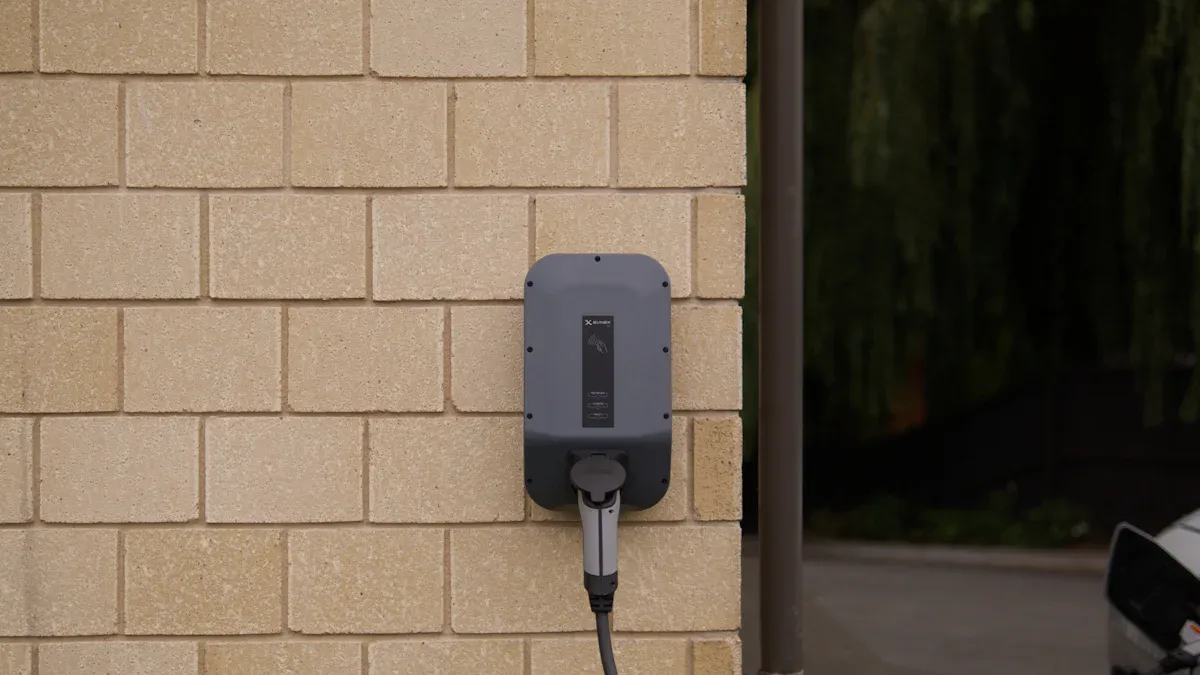
When you look at home charging stations, you’ll see three main types: Level 1, Level 2, and Level 3. Each one works a bit differently and fits different needs. Let’s break them down so you can pick the right electric vehicle charging station for your home.
Level 1 chargers are the simplest option. You just plug your EV into a regular 120V wall outlet. Most new electric cars come with a Level 1 charger, so you don’t need to buy extra equipment. Charging is slow, though. It can take 20 to 40 hours to fully charge your car. If you drive only a few miles each day, this might work for you. You won’t pay for installation, and your monthly electric bill will stay low—usually around $15 to $30.
Tip: Level 1 chargers are great if you have low daily mileage or want a backup charging method at home.
A level 2 charger is the most popular choice for home charging stations. You need a 240V outlet or a dedicated circuit, like what you use for a dryer. This setup charges your EV much faster—usually in 4 to 8 hours. You can add 10 to 30 miles of range per hour. The equipment costs between $500 and $2,000, and installation can cost $500 to $3,500, depending on your home. Most people with daily driving needs choose a level 2 home charger because it balances speed and cost. Your monthly electric bill may go up to $20 to $60, but you get the convenience of quick charging at home.
| Feature | Level 1 Charger | Level 2 Charger | Level 3 Charger |
|---|---|---|---|
| Power Source | 120V outlet | 240V outlet/circuit | High-voltage connection |
| Charging Speed | 20-40 hrs (full) | 4-8 hrs (full) | 20-40 min (80% charge) |
| Equipment Cost | Included with EV | $500-$2,000 | $10,000-$50,000+ |
| Installation Cost | None | $500-$3,500 | $20,000+ |
| Best Use | Low mileage | Daily drivers | Public/commercial use |
| Practicality for Home | High | High | Low |
Level 3 chargers, also called DC Fast Chargers, are the fastest way to charge an EV. They can give you an 80% charge in just 20 to 40 minutes. But these chargers need a commercial-grade power supply and special equipment. The equipment alone can cost $10,000 to $50,000 or more, and installation can be $20,000 or higher. Most homes can’t support this kind of power. Level 3 chargers work best for public places or businesses, not for a typical home charging station.
Note: If you see a Level 3 charger at a gas station or shopping center, you’ll know why—they’re built for speed and lots of use, not for home garages.
Choosing the right home EV charger depends on how much you drive, your budget, and your home’s electrical setup. For most people, a level 2 home charger offers the best mix of speed, cost, and convenience.
When you look at the cost of installing a home EV charger, the first thing you notice is the price of the charger itself. Most Level 2 home EV chargers cost between $300 and $800. Well-known brands like Siemens and JuiceBox usually fall in the $350 to $600 range. If you want a charger with more features, like Wi-Fi or faster charging, you might pay above $600. Here’s a quick look at some common options:
| Charger Type / Brand | Price Range (USD) | Notes |
|---|---|---|
| Typical Level 2 Home EV Charger | $300 - $800 | Most consumer models |
| Siemens or JuiceBox | $350 - $600 | Reputable brands |
| Higher-priced models | Above $600 | Smart features, faster speeds |
You also need to pay for professional installation. Electricians usually charge $400 to $1,200 for a standard job. If your home is newer and the charger goes near your panel, you might pay less. If your home is older or needs extra work, labor costs can go up. Always ask for a quote before you start your home charging installation.
Tip: Hiring a licensed electrician keeps your charging station installation safe and up to code.
Some homes need an electrical panel upgrade to handle the extra power. The average cost to upgrade a panel is $1,300 to $3,000. This price includes both the new panel and the labor. If your home needs a bigger upgrade, like moving the panel or adding a subpanel, the cost can go higher. Most people pay around $1,500 to $2,000 for this part of the installation.
Wiring and mounting add to the total cost of installing a home EV charger. If your charger sits close to your panel, you save money. If you need to run wires a long way or go through walls, costs rise. Expect to pay $10 to $20 per foot for wiring. Mounting the charger on a wall or pedestal is usually included in the installation costs, but special setups may cost extra.
Remember: Planning your installation carefully helps you avoid surprises and keeps your project on budget.
When you install a charger at home, you need to get permits and pass inspections. Most cities in the U.S. charge between $50 and $300 for these fees in 2025. These costs help make sure your installation meets safety rules and local codes. Skipping permits can lead to fines or problems with your insurance. You might even have trouble selling your home later if you don’t follow the rules. Always check with your city before starting your project.
Tip: Permits and inspections protect you and your home. They make sure your charger is safe to use.
Sometimes, your charger needs to be far from your electrical panel. If this happens, you may need extra wiring or even underground trenching. These steps can add a lot to your total cost. Here’s a quick look at what you might pay per foot:
| Cost Component | Cost Range per Foot | Explanation |
|---|---|---|
| Wiring and conduit | $10 to $20 | Depends on distance and how the wires are installed |
| Underground trenching | $4 to $12 | Needed if you must bury the cable outside |
If your charger is far from your panel, these costs can add up fast. Planning your installation close to your panel can help you save money.
Charging your EV at home will raise your monthly electric bill. Most people see an increase of about $56 to $60 each month, depending on how much you drive and your local rates. Here’s what some sources say:
| Source | Monthly Mileage | Monthly Cost (USD) |
|---|---|---|
| Palmetto | 1,123 miles | ~$59.84 |
| Energy Harbor | N/A | $56 |
| Kelley Blue Book | 1,015 miles | $59.05 |
You can track your usage and adjust your charging habits to control your costs.
Keeping your home EV charger in good shape is important. Most people spend between $200 and $400 each year on maintenance. This includes cleaning, checking cables, and making small repairs. Level 2 chargers may cost more to maintain than Level 1 chargers because they have more parts and may sit outside. Regular care helps your charger last longer and keeps it working safely.
Note: Some chargers come with a warranty or offer a maintenance plan for an extra fee. This can help you avoid big repair bills later.
You probably wonder how much it really costs to charge your EV at home compared to public stations. Let’s break it down. Charging at home is much cheaper per mile. You pay about $0.04 to $0.05 for every mile you drive when you use your home charging station. Public charging costs more. Level 2 public stations charge $0.06 to $0.08 per mile. DC fast chargers can cost $0.10 to $0.15 per mile. That means you spend up to 60% more at public stations.
Here’s a quick table to help you see the difference:
| Aspect | Home Charging | Public Charging |
|---|---|---|
| Cost per Mile | $0.04 – $0.05 | $0.06 – $0.08 (Level 2), $0.10 – $0.15 (DC Fast Charging) |
| Annual Cost (13,489 miles) | $506 – $720 | $770 – $963 (Level 2), $1,540 – $2,300 (DC Fast Charging) |
| Cost per kWh | $0.15 – $0.16 | $0.20 – $0.25 (Level 2), $0.40 – $0.60 (DC Fast Charging) |
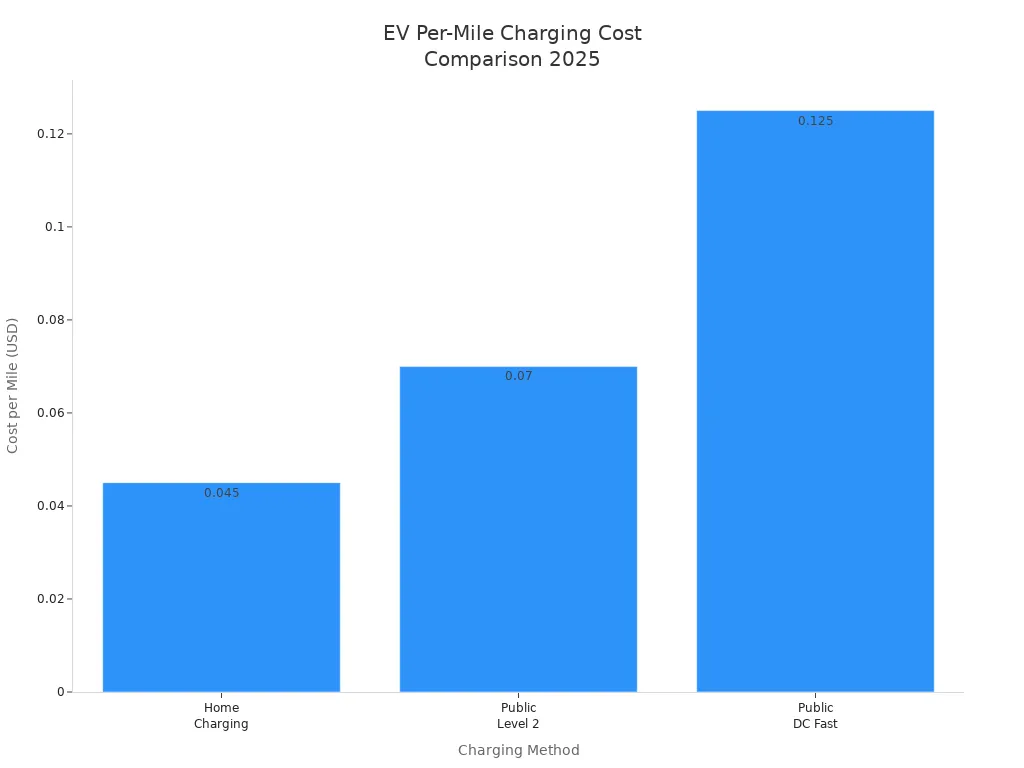
For example, if you drive a Tesla Model 3 Long Range in Oklahoma, you pay about $2.73 for 100 miles at home. At a public fast charger, you pay $6.75 for the same distance. That’s more than double!
Tip: Charging at home is not only cheaper, but you also avoid waiting in line at public stations.
When you look at the big picture, home charging stations save you thousands over time. Over five years, you spend about $2,500 to $3,000 charging at home. Public charging can cost $3,500 to $11,500 in the same period. That’s a huge difference!
| Charging Method | Annual Cost Range | Five-Year Cost Range | Notes |
|---|---|---|---|
| Home Charging | $500 - $600 | $2,500 - $3,000 | Lower electricity rates, possible tax credits |
| Public Charging | $700 - $2,300 | $3,500 - $11,500 | Higher rates, especially with fast chargers |
You also get federal and state rebates for installing home charging stations. Public stations don’t offer these perks. Charging at home is more convenient, too. You plug in overnight and wake up ready to go.
Note: Using public fast chargers often can wear out your battery faster, which means higher costs down the road.
Choosing home charging means you keep more money in your pocket and enjoy easy, reliable charging every day.
Do you want to save money on your home EV charger? In 2025, there are many ways to lower your costs. Let’s see how rebates and incentives can help you spend less.
The federal government gives you help to install a charger at home. You might get a tax credit for 30% of your total cost, up to $1,000. Here are some important things to know:
The 30C Alternative Fuel Infrastructure Tax Credit covers the charger, installation, and labor.
You must put the charger at your main home in a place that qualifies.
This credit is non-refundable, so it only lowers your tax bill.
You claim the credit by filling out IRS Form 8911.
The program lasts until June 30, 2026.
You can check if your address works by using the Department of Energy’s online tool.
If you add a battery with your charger, you can get a similar credit for energy storage.
Tip: You can use this federal credit with other EV purchase incentives to save even more money.
Many states and cities give extra help for home EV charger installation. Some offer rebates, while others give tax credits or grants. Here’s a quick look at what top EV states give:
| State | Incentives for Home EV Charger Installation |
|---|---|
| California | Rebates, tax credits, and programs like the California Electric Vehicle Infrastructure Project. Local utilities may offer discounts. |
| Florida | Utility grants and rebates. Some state grants for projects. Affordable energy rates help, too. |
| Washington | Tax credits, rebates, and sales tax exemptions for EVs and chargers. |
| New Jersey | $250 rebate for home charger purchase and installation. Sales tax exemption on EVs. |
| New York | Up to $2,000 in savings on EVs and grants for charging infrastructure. |
You might find more programs in your city or county. Always check with your local government or utility company.
Your electric company may also give you money back for a home charger. Many utilities offer rebates for Level 2 chargers. Some give $200, and others give up to $1,000. Here’s what some companies offer:
| Utility Company | Rebate Amount (USD) | Notes |
|---|---|---|
| Paulding Putnam Electric Cooperative | $200 | Residential and commercial customers |
| Hancock-Wood Electric Cooperative | $250 | For Level 2 charger purchase |
| Lorain-Medina Rural Electric Cooperative | $250 | Purchase and installation rebate |
| Butler Rural Electric Cooperative | Up to $1,000 | Higher rebate for purchase and installation |
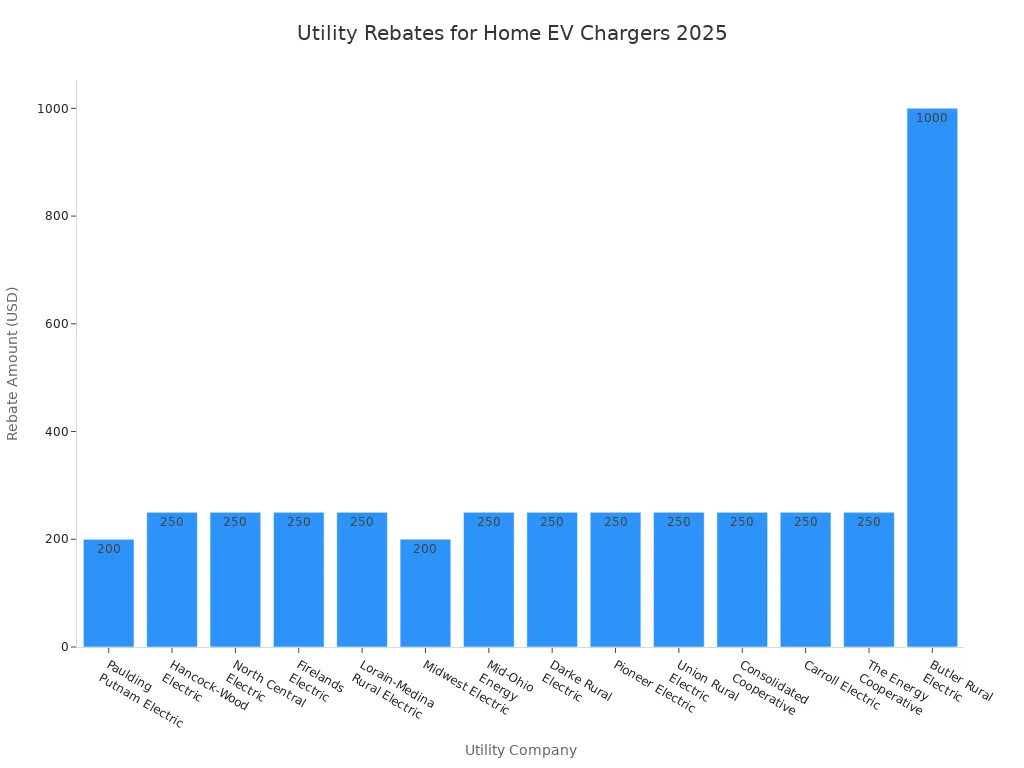
Note: Utility rebates can change every year. Check with your provider before you buy your charger.
You can use all these savings together. Combine federal, state, and utility programs to pay less for your home EV charger.
Thinking about putting in a home EV charger? You might wonder if you should do it yourself or call a certified electrician. Let’s look at why hiring a pro makes sense.
Certified electricians go through tough training and know all the local and national electrical rules. You get someone who understands how to install EV chargers safely and correctly.
These experts follow strict safety standards. You lower the risk of accidents, fires, or damage to your home and car.
When you hire a certified electrician, you protect your property and your family. You also keep your warranties safe and make sure your charger works well for years.
Professionals handle all the paperwork, permits, and even talk to your utility company. You save time and avoid headaches.
Many states require a licensed electrician for this kind of work. You stay on the right side of the law and insurance rules.
Certified electricians offer support after the install. If you have questions or need help later, you know who to call.
Tip: A certified electrician helps you qualify for rebates and incentives, making your install more affordable.
Trying to install a home EV charger by yourself can lead to big problems. Here are some risks you should know about:
You face electrical hazards like shocks or fires if you wire things wrong or skip proper grounding.
Mistakes can void warranties on your charger, your EV, and even your home insurance.
If you don’t follow local codes or get permits, you might pay fines or have trouble selling your house later.
Using the wrong materials or overloading circuits can cause wires to melt or spark, leading to fire risks.
Failed inspections mean you spend more money fixing mistakes. You lose time and peace of mind.
Many DIY jobs miss important steps, like using the right wire type or tightening connections. These errors can cause damage over time.
Note: Professional installation keeps your charger safe, your home protected, and your EV ready to go.
You can expect the total cost for a home EV charger in 2025 to range from $551 to $2,500, depending on your setup and needs. Always look for rebates and incentives to lower your upfront cost. Here’s a quick table showing some top programs:
| Rebate Source | Amount | Notes |
|---|---|---|
| JEA | $300 | For electrical upgrades |
| KUA | $200 | For charger purchase |
| ComEd | Up to $3,750 | Income-based, covers install |
Safety matters, so hire a certified installer and use quality parts. With a home charger, you get convenience, save money, and boost your property value.
Plug in overnight and wake up ready to go.
Charging at home is cheaper than public stations.
Smart chargers let you control and track energy use.
Your home’s value goes up with a charger.
Most electricians finish the job in 2 to 4 hours. If your home needs upgrades or extra wiring, it might take a full day. You can usually use your charger the same day.
You should always hire a licensed electrician. Installing a Level 2 charger involves high voltage and special wiring. Doing it yourself can be dangerous and may void your warranty.
Yes, you will see a higher bill. Most people pay about $56 to $60 more each month, depending on how much they drive and local electricity rates.
In most places, you need a permit for safety and code reasons. Check with your city or county before starting. Permits help protect your home and make sure your charger works safely.